
Mechanism
Growth factor support
Preserved tissue components help reintroduce biologic signals associated with cell migration, granulation, and a more productive healing cascade.
Science
Chronic wounds rarely fail because clinicians lack urgency. They stall because the wound environment remains inflamed, structurally compromised, or biologically quiet. Amniotic membrane helps address those barriers with a combination of matrix structure and tissue-derived signaling.
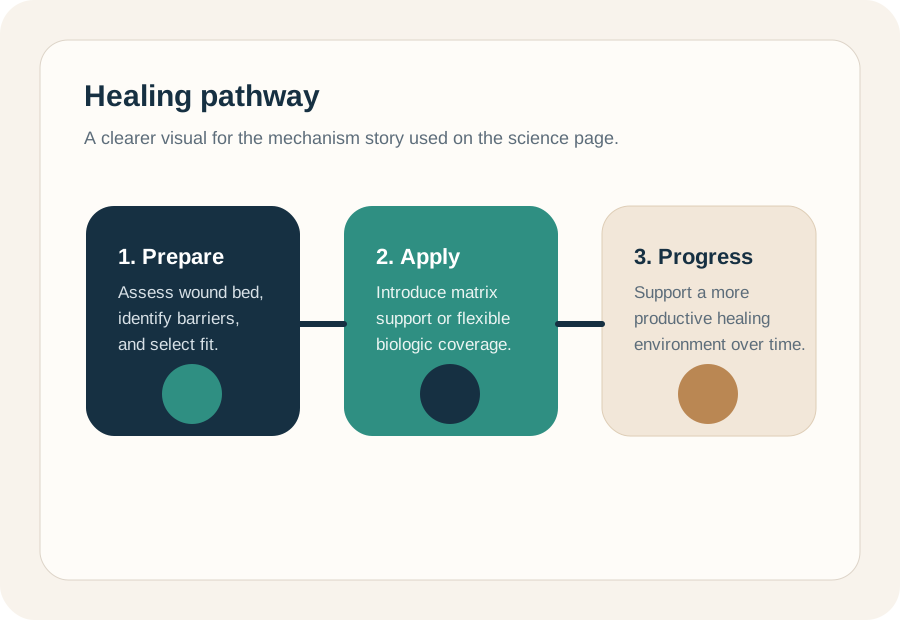
Mechanism
Preserved tissue components help reintroduce biologic signals associated with cell migration, granulation, and a more productive healing cascade.
Healing environment
Amniotic tissue is valued for helping shift the wound away from prolonged inflammation, giving clinicians a better platform for tissue progression and pain-reduction strategies.
Structure
The extracellular matrix offers a structural framework that supports cell attachment and tissue organization where standard dressings alone may not be enough.
Where it fits
This page now carries the biological story that used to sit inside the one-page build. It gives physicians and internal reviewers a cleaner explanation of how the wound environment, matrix support, and biologic signaling relate to product choice.
Clinical conversations
Keep this page focused on the clinical logic: what chronic wounds need, what barriers often persist, and how amniotic membrane is typically framed within advanced wound-healing pathways.
Chronic wound programs
Use the science framing to explain why a standard dressing may not be enough when a wound remains stalled despite consistent care.
Complex geometry
The mechanism story becomes more credible when teams understand why structured sheet placement and flexible delivery are different pathways, not competing slogans.
Our commitment to safety, ethics, and traceability begins at the source. Every amniotic membrane tissue is procured under strict regulatory and ethical guidelines.
We partner exclusively with certified birthing centers and participate in the Mothering Hospital Program. All donations are voluntary, uncompensated, and screened for communicable diseases per FDA 21 CFR 1271 guidelines. Informed consent is obtained prior to every scheduled Cesarean delivery.
NextGen Biologics products are regulated as HCT/Ps under Section 361, not 351. This means they are minimally manipulated, intended for homologous use, and do not contain systemic effects. Our tissues bypass drug-level regulatory hurdles while meeting the highest safety standards.
From recovery to delivery, every tissue lot is tracked via a unique identifier. Full chain-of-custody logs include donor screening results, processing timestamps, quality control assays, and final distribution records. Available for audit upon request.
Our proprietary processing protocol preserves native extracellular matrix architecture and growth factors while eliminating immunogenicity.
Tissue recovered in a sterile OR environment within 12 hours of scheduled C-section. Aseptic techniques applied throughout.
Maternal blood tested for HIV 1/2, HBV, HCV, Syphilis, CMV, and Zika. Only eligible donors proceed to processing.
Cryopreservation and dehydration methods maintain structural integrity. No harsh chemicals or terminal irradiation used.
Each lot undergoes aerobic/anaerobic culture, endotoxin testing, and growth factor quantification before release.
Transparency in product specifications ensures confidence in clinical application.
See how NextGen Biologics processing methods align with or exceed traditional amniotic tissue protocols.
Next step
Once the mechanism makes sense, the next questions are usually which product fits best and what support material backs the decision.
NextGen Biologics employs a proprietary dehydration and sterilization process that maintains the native extracellular matrix architecture. Unlike gamma-irradiated alternatives that can fragment collagen fibers, our low-temperature processing preserves growth factor bioavailability and basement membrane integrity.
Scanning electron microscopy confirms retention of the three-dimensional fibrous network across all product lots. This structural preservation is critical because wound bed integration depends on the scaffold's ability to support fibroblast infiltration and angiogenesis during the proliferative phase of healing.
Every lot undergoes rigorous testing for sterility, endotoxin levels, and bioburden per USP <71> and AAMI ST72 standards. Documentation is maintained in compliance with 21 CFR Part 1271 for HCT/Ps, and certificates of analysis are available upon request for credentialing committees and formulary review boards.
View Clinical Evidence & Outcomes →Connect with our clinical specialists to explore next-generation solutions for your clinical or research needs.
Request a Consultation